

Artificial intelligence is transforming software development at an incredible pace.
From chatbots and virtual assistants to content generation and business automation, AI-powered applications are becoming an essential part of modern technology. However, many beginners assume that integrating AI into an application requires advanced machine learning expertise.
The reality is far more exciting.
With the OpenAI API, developers can add powerful AI capabilities to websites, apps, and business systems without building complex AI models from scratch.
Whether you’re a student, developer, entrepreneur, or business owner, learning how to use the OpenAI API can unlock countless opportunities.
In this beginner-friendly guide, you’ll learn exactly how the OpenAI API works, how to get started, and how to build your first AI-powered application in 2026.
What Is the OpenAI API?
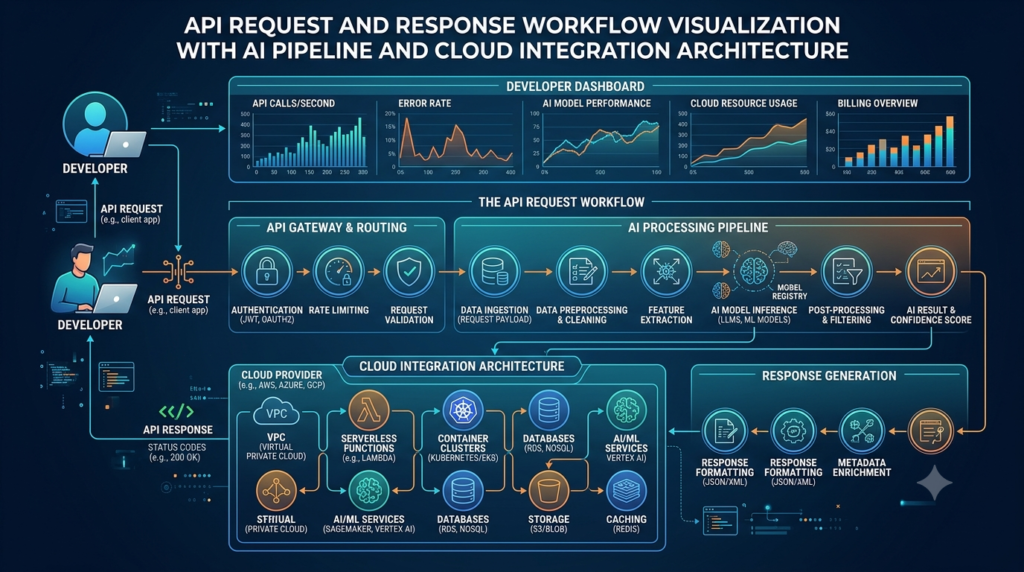
The OpenAI API is a cloud-based service that allows developers to access advanced artificial intelligence models through simple API requests.
Instead of creating and training AI models yourself, you can connect directly to OpenAI’s powerful systems and use them within your applications.
The API can perform tasks such as:
- Text generation
- Content creation
- Chatbots
- Code generation
- Language translation
- Data analysis
- Research assistance
- Customer support automation
As a result, developers can build intelligent applications much faster and more efficiently.
Why Developers Are Using the OpenAI API
The demand for AI-powered software continues to grow rapidly.
Businesses want smarter customer support systems, content creators need automation tools, and developers are searching for ways to improve user experiences.
The OpenAI API solves these challenges by providing access to advanced AI capabilities through a simple integration process.
Key benefits include:
- Faster development
- Powerful AI capabilities
- Easy integration
- Scalable infrastructure
- Continuous improvements
- Reduced development costs
Consequently, thousands of startups and enterprises rely on AI APIs to power their products.
Step 1: Create an OpenAI Account
Before using the API, you’ll need an account.
The setup process is straightforward:
- Create an account.
- Verify your email address.
- Complete account setup.
- Access the developer dashboard.
Once your account is active, you’ll be able to manage API access and monitor usage.
Step 2: Generate Your API Key
An API key acts as a secure authentication token.
It allows your application to communicate with OpenAI’s servers.
To generate an API key:
- Open the developer dashboard.
- Navigate to API settings.
- Create a new API key.
- Copy and store the key securely.
Important:
Never share your API key publicly.
Anyone with access to the key may be able to use your API credits.
Step 3: Understand API Requests
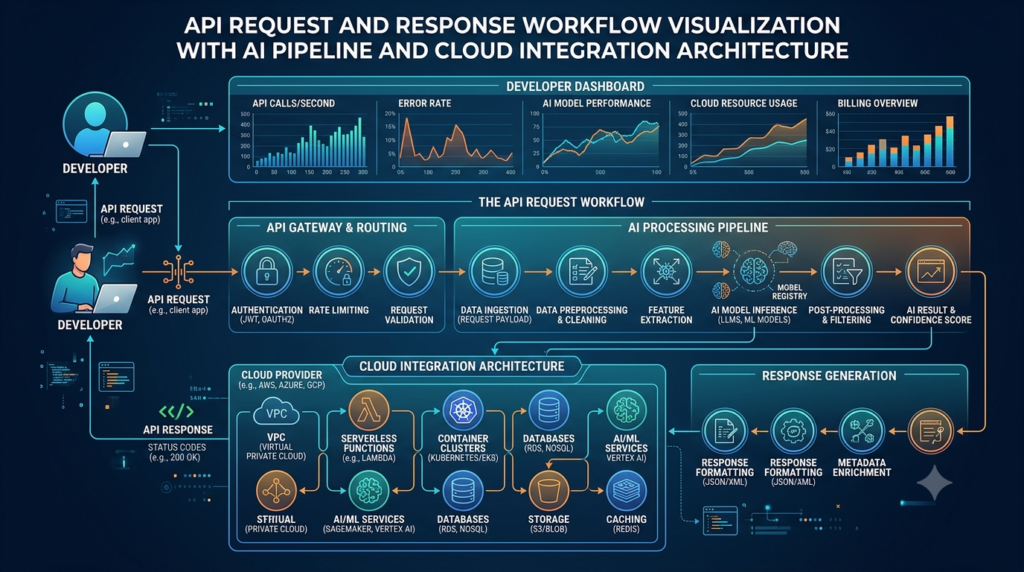
The OpenAI API works by sending requests and receiving responses.
The basic workflow looks like this:
Input
You send a prompt or instruction.
Processing
The AI model analyzes the request.
Output
The API returns a response.
For example:
Prompt:
“Write a professional email welcoming a new customer.”
Response:
A complete, AI-generated email.
This simple process powers countless AI applications worldwide.
Step 4: Make Your First API Call
Once your API key is ready, you can send your first request.
A typical workflow includes:
- Authentication
- Prompt submission
- Response processing
- Displaying results
Many developers begin with simple chatbot projects before expanding into more advanced applications.
As a result, beginners can quickly gain confidence working with the API.
Step 5: Build Real-World AI Applications
The OpenAI API can power a wide variety of applications.
Popular use cases include:
AI Chatbots
Provide instant customer support and user assistance.
Content Creation Tools
Generate articles, emails, marketing copy, and social media content.
Coding Assistants
Help developers write, review, and optimize code.
Research Tools
Summarize information and answer complex questions.
Business Automation
Automate repetitive tasks and improve operational efficiency.
These applications help businesses save time while improving productivity.
Understanding API Pricing
One of the most important factors for beginners is understanding costs.
OpenAI pricing generally depends on:
- Model selection
- Input usage
- Output usage
- Request volume
Smaller projects often remain highly affordable, while larger applications may require more advanced budgeting.
Therefore, monitoring usage regularly is recommended.
Best Practices for Using the OpenAI API
To achieve the best results, follow these proven practices:
Write Clear Prompts
The quality of output often depends on the quality of input.
Protect API Keys
Always store keys securely and avoid exposing them publicly.
Monitor Usage
Track API consumption to avoid unexpected costs.
Test Multiple Prompts
Small prompt adjustments can dramatically improve results.
Optimize Responses
Refine prompts continuously for better performance.
These practices help maximize both efficiency and accuracy.
Common Mistakes Beginners Should Avoid
Many new developers encounter similar challenges.
Common mistakes include:
- Using vague prompts
- Exposing API keys
- Ignoring usage limits
- Expecting perfect results immediately
- Failing to test different prompt structures
Fortunately, these issues can be avoided with proper planning and experimentation.
The Future of AI APIs
Artificial intelligence is evolving faster than ever.
Future AI APIs will become increasingly powerful, capable, and personalized.
Instead of simply generating text, next-generation AI systems will assist with decision-making, automation, collaboration, and complex problem-solving.
Developers who begin learning AI integration today will be well-positioned for future opportunities.
Consequently, understanding APIs is becoming one of the most valuable skills in modern software development.
Final Thoughts
The OpenAI API has made advanced artificial intelligence more accessible than ever before.
What once required large research teams and massive computing resources can now be integrated into applications with only a few API calls.
Whether you’re building chatbots, automating business processes, creating content tools, or exploring AI development for the first time, the OpenAI API offers a powerful foundation for innovation.
By learning how to use the OpenAI API today, you’ll gain practical skills that can help you build smarter applications and stay ahead in the rapidly evolving world of artificial intelligence.
FAQ
What is the OpenAI API used for?
The OpenAI API is used for AI-powered applications such as chatbots, content generation, coding assistants, automation systems, and research tools.
Do I need coding experience to use the OpenAI API?
Basic programming knowledge is helpful, but many beginners can learn API integration quickly using available documentation and tutorials.
Is the OpenAI API free?
Some features may have free access limits, but most production use is based on usage-based pricing.
Can businesses use the OpenAI API?
Yes. Businesses use the OpenAI API for customer support, automation, content creation, analytics, and productivity solutions.