
In a landmark move that signals the next phase of the artificial intelligence wars, Google has officially begun the broad rollout of Personal Intelligence to all users across the United States. Previously locked behind the paywall of Google AI Pro and Ultra subscriptions, this suite of features is now becoming a standard part of the Google experience for hundreds of millions of people.Google Broadens personal intelligence access across the united states.
As of March 2026, the barriers between your digital assistant and your personal data are dissolving—safely, according to Google—to create an AI that doesn’t just know the world, but knows you.
The Evolution: From Static Search to Personal Intelligence
For decades, Google Search was a window into the world’s information. You typed a query, and Google provided the most relevant public results. With the introduction of the Gemini AI ecosystem, that window became a conversation. However, even the most advanced AI models lacked one critical component: context.
Without Personal Intelligence, if you asked Gemini, “When is my flight?” or “What kind of tires does my car need?”, it would likely give you general travel tips or a list of common tire brands.Visit our internal link for more.
What is Personal Intelligence?
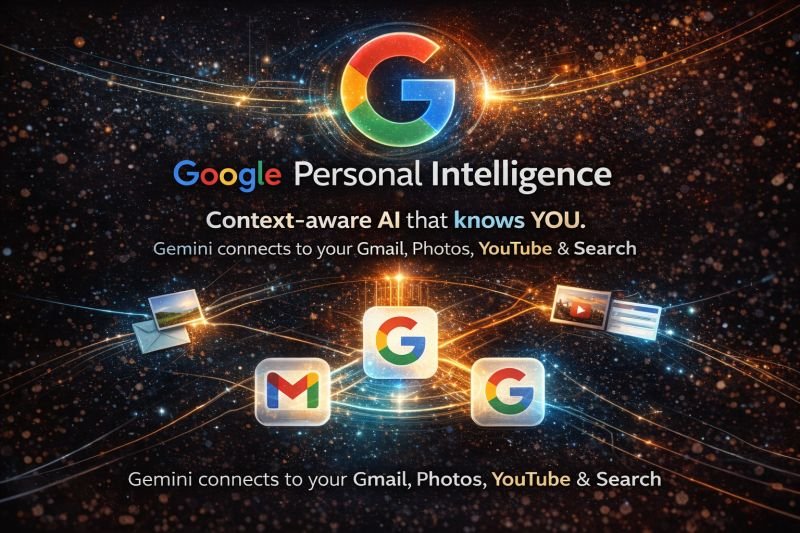
Personal Intelligence is an opt-in layer of the Gemini AI that allows the model to securely “read” and synthesize information from your specific Google services, including:
- Gmail: To track receipts, flight confirmations, and event invitations.
- Google Photos: To recognize people, places, and objects in your library to answer visual queries.
- Google Maps & Calendar: To understand your schedule and location preferences.
- YouTube & Search History: To tailor recommendations based on your actual interests.
The 2026 Rollout: What’s New?
The March 2026 update represents a massive scaling effort. While the “Beta” version launched in January for paid users, the current expansion brings these capabilities to three primary interfaces:
- AI Mode in Search: Google’s revamped search interface now includes a “Personal” toggle. When enabled, search results are grounded in your personal data.
- The Gemini App: The standalone app on Android and iOS is receiving a server-side update that enables “Connected Apps” for free-tier users.
- Gemini in Chrome: A new side-panel integration in the Chrome browser allows the AI to assist you while you browse, drawing on your Google history to simplify tasks like filling out forms or researching products.
Real-World Use Cases: How It Changes Your Daily Life
The true value of Personal Intelligence isn’t in its technical architecture, but in its utility. Google has highlighted several key scenarios where this integration saves time and mental energy.
1. Troubleshooting Without the Manual
Imagine your smart refrigerator starts making a strange noise. In the past, you’d have to find the model number, search for the manual, and scroll through PDFs. With Personal Intelligence, you can simply ask Gemini: “Why is my fridge making a buzzing sound?” The AI looks through your Gmail for the digital receipt or warranty registration, identifies the exact model, and provides specific troubleshooting steps—like a factory reset or power cycle—tailored to that device.
2. Hyper-Personalized Shopping
The partnership between Google and retail giants like Walmart and The Home Depot has integrated directly with Personal Intelligence. If you are looking for a bag to match a pair of shoes you bought last month, Gemini doesn’t just show you “bags.” It pulls the color and hardware details from your previous purchase receipt in Gmail to suggest options that perfectly complement your existing wardrobe.
3. Seamless Travel Planning
Travel planning is notoriously fragmented. You have a flight in one email, a hotel in another, and a restaurant recommendation saved in a YouTube video.
- The Personal Intelligence Solution: You can prompt Gemini: “Create an itinerary for my upcoming Chicago trip.” * The Result: Gemini synthesizes the flight times from your inbox, suggests activities based on your “hidden gems” YouTube history, and maps out the walking distance between your hotel and the airport gate.
The Privacy Question: Is My Data Safe?
Whenever an AI “reads” your emails, red flags go up regarding privacy. Google has been proactive in addressing these concerns, emphasizing that Personal Intelligence is built on a foundation of “Transparency, Choice, and Control.”
Key Privacy Safeguards:
- Off by Default: Personal Intelligence is an opt-in feature. Users must manually connect their apps through the Gemini settings.
- No Direct Training: Google has explicitly stated that Gemini does not train its foundational models directly on your private Gmail or Photos content.
- Per-App Controls: You can give Gemini access to your Maps and YouTube history while keeping your Gmail private.
- Obfuscation: When data is used to improve the service, Google uses “differential privacy” techniques to ensure that specific personal identifiers are stripped away before any feedback reaches human reviewers or automated systems.
Note for Workspace Users: It is important to note that this rollout is currently limited to Personal Google Accounts. Users on Workspace Business, Enterprise, or Education accounts do not yet have access to these features due to stricter data governance and compliance requirements.
The Competitive Landscape: Google vs. Apple
The timing of this rollout is no coincidence. Apple has been teasing its own “Apple Intelligence” features for Siri, promising deep integration with iMessage and Apple Photos. However, Apple’s rollout has faced several delays, with many features not expected until late 2026.
By pushing Personal Intelligence to the free tier now, Google is positioning Gemini as the “everywhere” assistant. Because Google’s ecosystem is cross-platform (working on iPhone, Android, and Windows), they are effectively making a play to become the default personal AI for everyone, regardless of what hardware they carry.
Looking Ahead: The Road to “Project Jarvis”
Industry insiders view the expansion of Personal Intelligence as a stepping stone toward Project Jarvis—Google’s rumored “Computer-Using Agent.” The goal of Jarvis is to go beyond answering questions and actually execute tasks on your behalf, like booking the flight it just found or purchasing the groceries for a recipe it suggested.
By teaching the AI to understand the nuances of a user’s personal life now, Google is building the memory and context required for those future “agentic” capabilities.
Conclusion: Should You Enable It?
For the power user, Personal Intelligence is a “game-changer.” It reduces the friction of daily life and turns a chatbot into a genuine digital secretary. However, for the privacy-conscious, the trade-off may still feel steep.
The beauty of the 2026 update is that the choice is entirely yours. You can experiment with specific app connections or keep the AI strictly focused on the public web.
Ready to try it out? You can check if the feature has reached your account by visiting the Gemini Settings page and looking for the “Personal Intelligence” or “Extensions” tab.

Internal & External Links for Reference
- Internal (apkmirror.shop): Download the latest Gemini APK
- Internal (apkmirror.shop): Google Search AI Mode: A Setup Guide
- External: Google’s Official Blog: Personal Intelligence Expansion
- External: Understanding AI Data Privacy at Google
This expansion of Personal Intelligence is more than just a software update; it’s a shift in how we interact with our digital lives. To help your readers at apkmirror.shop navigate this new landscape, here are the essential FAQs and a breakdown of the top products integrated with this technology.
Frequently Asked Questions (FAQ)
1. Is Personal Intelligence really free now?
Yes. As of March 2026, Google has expanded Personal Intelligence to the free tier for all personal Google accounts in the United States. Previously, this was a “Pro” and “Ultra” exclusive feature. You can now use it in the Gemini app, AI Mode in Search, and the Gemini side-panel in Chrome without a monthly subscription.
2. Which Google Apps can I actually connect?
The current rollout supports deep integration with:
- Gmail & Drive: For finding receipts, flight info, and summarizing documents.
- Google Photos: For identifying objects, people, or dates within your images.
- Google Calendar & Keep: For managing schedules and pulling from your notes.
- YouTube & Maps: For personalized travel routes and video-based recommendations.
3. Does this work for my work (Workspace) account?
No. Currently, Personal Intelligence is restricted to personal @gmail.com accounts. Because of strict data privacy and compliance regulations, Google has not yet rolled this out to Workspace Business, Enterprise, or Education tiers.
4. Will Gemini use my private emails to train its public AI?
Google states that it does not train its global foundational models directly on your private Gmail inbox or Google Photos library. While it uses limited “prompt and response” data to improve your specific experience, your private data stays siloed from the public training set.
5. How do I turn it off if I don’t like it?
The feature is opt-in only. You can manage or revoke access at any time by going to Gemini Settings > Personal Intelligence > Connected Apps. You can also disable it for a single chat session if you’re asking a sensitive question you don’t want linked to your history.
Top Products & Features Powered by Personal Intelligence
The 2026 expansion has turned several “static” Google products into proactive agents. Here are the top tools currently leading the charge:
1. AI Mode in Google Search
This isn’t just a “summary” at the top of the page anymore. When you search for something like “status of my order,” the Personal Intelligence layer checks your Gmail for tracking numbers and displays a real-time progress bar directly in the search results, saving you from digging through your inbox.
2. Agentic Vision (Gemini 3 Flash)
Integrated into the Gemini app, Agentic Vision allows the AI to “investigate” your photos. If you take a picture of a complex engine part or a broken appliance, the AI uses Personal Intelligence to cross-reference your purchase history, identify the exact model, and then “act” by finding the specific repair manual or local parts store.
3. Gemini in Chrome (Side-Panel)
The Chrome integration is a sleeper hit for productivity. While you’re on a travel booking site, you can open the side panel and ask, “Does this hotel conflict with any of my appointments in April?” The AI checks your Google Calendar and Gmail in real-time to give you a “Yes/No” answer without you ever leaving the tab.
4. Smart Shopping Agent
By connecting to your Google Shopping and Gmail history, Gemini acts as a high-end personal shopper. It knows your sizes, preferred brands, and even the “hardware style” of items you already own (e.g., gold vs. silver zippers) to suggest matching accessories from retailers like Walmart or The Home Depot.
Quick Comparison: Free vs. Paid (March 2026)
| Feature | Free Tier | AI Pro / Ultra |
| Personal Intelligence | Included (U.S. Only) | Included (Global) |
| Context Window | 32,000 Tokens | 1,000,000+ Tokens |
| Deep Research | 5 Reports / Month | 20+ Reports / Day |
| Image Generation | 3 Images / Day | 100+ Images / Day |
| Model Access | Gemini 3 Flash | Gemini 3.1 Pro / Ultra |
Internal & External Links for Your Post
- Internal (apkmirror.shop): How to sideload the latest Gemini App update
- Internal (apkmirror.shop): Top 5 Gemini Extensions you should enable today
- External: Official Google Privacy Hub for Gemini
- External: Google’s “Project Jarvis” Roadmap (9to5Google)
To help your users at apkmirror.shop fully master this new ecosystem, I’ve detailed the specific tools and technical methods required to bridge the gap between a standard Android device and a fully-powered Personal Intelligence hub.
Technical Methods: Optimizing Your Personal Intelligence Setup
For the power users on your site, simply “toggling a switch” isn’t enough. These methods ensure the AI performs with the highest accuracy and lowest latency.
1. The “Clean Data” Method (Improving Accuracy)
Personal Intelligence is only as good as the data it reads. If your Gmail is cluttered with 10,000 unread newsletters, Gemini may struggle to find your flight info.
- The Method: Use Gmail Filters to label essential “Action” emails (Receipts, Travel, Utilities).
- Pro Tip: In Gemini settings, you can specifically instruct the AI to “Prioritize emails labeled ‘Important’ when searching for travel or financial data.”
2. Sideloading for Early Access (The APK Mirror Way)
Often, Google rolls these features out via “Server-Side Updates” tied to specific versions of the Google App and Gemini App.
- The Method: Users can bypass regional or staged rollout delays by downloading the latest Beta Architecture versions of the Google App.
- Link Suggestion: Check our Latest Google App Beta APKs
3. The “Contextual Prompting” Technique
To get the most out of Personal Intelligence, users need to change how they talk to the AI. Instead of asking “Where is my package?”, use Anchor Prompts.
- Method: “Using my recent emails from the last 48 hours, find the tracking number for my UPS delivery and tell me the current ETA.” This forces the AI to look at a specific time-bound data set, reducing hallucinations.
Top 5 Related Tools for Enhancing Personal AI
While Gemini is the core engine, these supporting tools and extensions are essential for a seamless “Personal Intelligence” experience in 2026.
1. Gemini Live (Mobile Voice Interface)
Gemini Live is the conversational layer of Personal Intelligence. It allows you to have a hands-free, back-and-forth dialogue about your personal data.
- Best For: Brainstorming travel plans while driving or asking about your schedule while cooking.
- Key Feature: You can interrupt it mid-sentence to refine your query (e.g., “Wait, check my other email for that receipt instead”).
2. Google Task Mate (Data Refinement)
To make Personal Intelligence smarter, Google uses Task Mate to allow users to verify AI-generated summaries.
- Best For: Users who want to “train” their personal instance of the AI to recognize specific handwriting or niche document formats in their Google Drive.
3. The “Gemini Side-Panel” for Chrome
This isn’t just a bookmark; it’s a persistent tool that stays with you across the web.
- Best For: Comparing web prices against your past purchase history.
- Usage: Open the side panel while on an e-commerce site, and it will automatically highlight if you’ve bought a similar item before, based on your Gmail history.
4. Android “Circle to Search” + Personal Intelligence
Google has merged these two features. You can now circle a product on Instagram, and Gemini will instantly tell you if you have a discount code for that specific brand sitting in your inbox.
- Requirement: Requires the latest Google Play Services update.
5. Google One Storage Manager (The Data Foundation)
Since Personal Intelligence relies on your Drive and Photos, running out of space breaks the AI’s “memory.”
- Tool Tip: Use the Storage Manager to clear out large, blurry photos so Gemini’s “Vision” stays focused on your high-quality memories and important documents.
Step-by-Step: How to Enable “Personal Intelligence” on Android
For your readers who have just downloaded the APK from your site, here is the quick-start guide:
- Update: Ensure you have the latest Google App and Gemini App (available on apkmirror.shop).
- Access Settings: Open the Gemini App > Tap your Profile Picture > Settings.
- Extensions: Tap on “Extensions” (In some versions, this is now labeled “Connected Apps”).
- Toggle Access: Switch on the toggles for Google Workspace (Gmail, Drive, Docs), Google Maps, and YouTube.
- Verify: Ask Gemini a test question like, “What was the last thing I bought on Amazon?” to confirm it can read your digital receipts.
Resources & Downloads
- Internal: Fixing “Extension Not Found” Errors in Gemini
- Internal: Top 10 Gemini Prompts for Personal Productivity
- External: Google’s Official Guide to Gemini Extensions
- External: XDA Developers: How Google’s Personal Intelligence Architecture Works